How Art Critics Judge a Painting
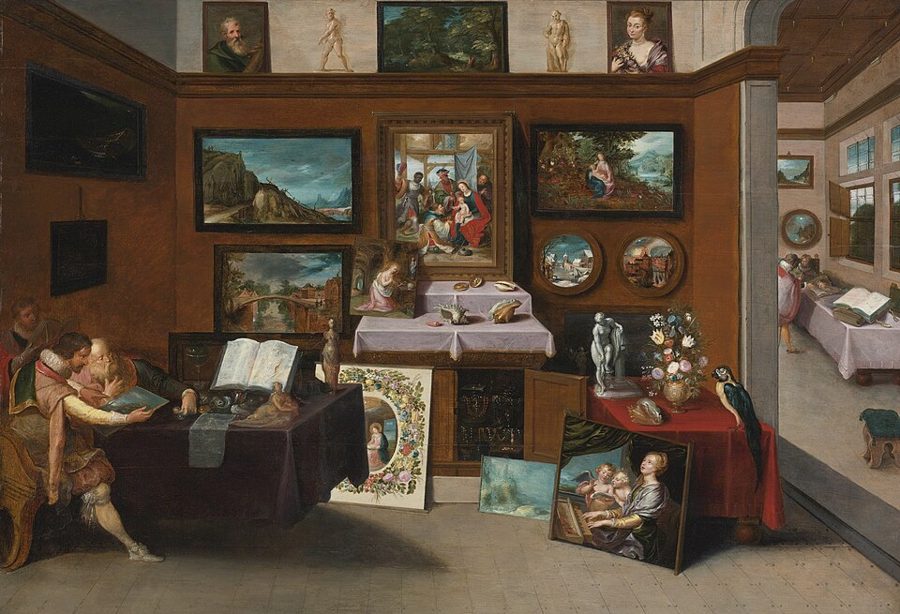
Art critics judge a painting by testing what it appears to attempt against what it actually delivers on the canvas, then placing that result in the context of the artist, the period and the place where it hangs. The working criteria are fairly stable: intention, form, material, context and effect on the viewer. What changes from critic to critic is the weight given to each, and the history of criticism since Denis Diderot's Salon reports in the 1750s is largely a record of those shifting weights. A credible judgement shows its evidence, so a reader can check the argument against the picture.
The criteria at a glance
Most serious reviews, whatever their tone, work through the same handful of questions. The table below sets them out with the kind of evidence a critic needs for each, and the trap that weak criticism falls into.
| Criterion | Question the critic asks | Evidence used | Common failure |
|---|---|---|---|
| Intention | What is the painting trying to do? | Subject, title, series, artist's other work | Treating the press release as proof |
| Form | Do composition, colour and scale serve that aim? | Specific passages of the surface | Listing features without saying what they do |
| Material and technique | Is the making fit for the image? | Brushwork, layering, support, finish | Equating polish with quality |
| Context | How does it sit within its tradition and moment? | Art history, the exhibition, the room | Using context to excuse a weak object |
| Effect | What response does the work earn? | The viewer's experience, tied to visible causes | Mood borrowed from the label |
None of these is decisive alone. A technically modest canvas can succeed if every decision supports its aim, and a dazzling one can fail if the dazzle has nothing to carry.
Intention and the problem of the artist's word
Critics start by asking what a painting seems to want, but they are cautious about taking the artist's account as the last word. The American critic Jerry Saltz, senior art critic at New York magazine since 2006 and winner of the 2018 Pulitzer Prize for Criticism, has described his approach in two parts: "I'm looking for what the artist is trying to say and what he or she is actually saying, what the work reveals about society" (quoted in his Wikipedia biography). The gap between those two things is often where a review finds its subject.
The scepticism has a theoretical pedigree. In 1946 William K. Wimsatt and Monroe Beardsley argued in The Sewanee Review that "the design or intention of the author is neither available nor desirable as a standard for judging the success of a work" (The Intentional Fallacy). Their essay addressed literature, but art critics absorbed the point. An artist statement is context. It does not settle whether the painting works.
In practice, a critic reads the statement after looking, then returns to the canvas. If the text promises unease and the picture delivers decoration, the mismatch goes into the review.
Form and the formalist tradition
Form covers composition, colour relationships, edges, scale, surface and the physical presence of the object. For much of the twentieth century, British and American criticism treated form as the main criterion. Tate defines formalism as "the critical position that the most important aspect of a work of art is its form – the way it is made and its purely visual aspects – rather than its narrative content or its relationship to the visible world."
The position took shape in Bloomsbury London. Roger Fry organised Manet and the Post-Impressionists at the Grafton Galleries in November 1910 and coined the term Post-Impressionism for the show. His collected essays, Vision and Design (1920), argued that our emotional response to painting comes from line, mass, colour and design rather than subject (Roger Fry). Clive Bell pushed the idea further in his 1914 book Art, built around the notion of significant form: "The important thing about a picture, however, is not how it is painted, but whether it provokes aesthetic emotion."
In New York, Clement Greenberg carried formalism to its peak. His essay Avant-Garde and Kitsch appeared in Partisan Review in 1939, and he went on to champion abstract painting that emphasised the flatness of the picture plane. Few critics now accept formalism as a complete method, yet its habit of tying every claim to a visible feature remains the backbone of good reviewing. "It feels powerful" is a reaction. "The dark band across the lower third presses the lighter figures upward" is evidence.
Material, technique and fitness for purpose
Technique is judged by fitness, not by finish. Thick impasto can carry urgency; thin glazes can create distance; visible corrections can record thinking. A rough surface may be fully deliberate, and a smooth one may be dead if it only imitates competence.
The classic British test case is the libel action Whistler brought against John Ruskin. In Fors Clavigera on 2 July 1877, Ruskin attacked Whistler's Nocturne in Black and Gold: The Falling Rocket (1874), writing that he "never expected to hear a coxcomb ask two hundred guineas for flinging a pot of paint in the public's face" (Whistler v. Ruskin). At the trial on 25 and 26 November 1878, Whistler was asked whether he charged that sum for two days' work. He replied: "No, I ask it for the knowledge I have gained in the work of a lifetime." The jury found for Whistler but awarded a farthing in damages. The painting is now in the Detroit Institute of Arts.
The case still frames a central question for critics: whether speed and apparent looseness signal carelessness or mastery. Ruskin, whose five-volume Modern Painters (1843 to 1860) began as a defence of Turner's late work, valued what he called truth to nature. Whistler valued tonal harmony. Both were applying criteria; they disagreed about which ones mattered.
Context, history and the setting
No painting arrives alone. Critics weigh the artist's earlier work, the tradition the painting enters and the conditions under which it is seen. A still life made after four centuries of still life has to justify itself, though novelty is only one way to do that. It might slow attention, test a material, or make an old format carry a new subject.
The setting matters too. A quiet canvas can gain force in a crowded group show, and a large one can lose its edge under poor lighting or a cramped hang. A critic reviewing an exhibition is reviewing an encounter, so installation belongs in the judgement.
Context is also where critics are most often wrong. On 25 April 1874, Louis Leroy reviewed the first independent exhibition of the group around Monet in the satirical paper Le Charivari, under the title "The Exhibition of the Impressionists". Looking at Monet's Impression, Sunrise, he wrote that "a preliminary drawing for a wallpaper pattern is more finished than this seascape" (Louis Leroy). The mockery gave the movement its name; the Impressionists adopted it. Fry's 1910 exhibition met similar hostility, and his friend Desmond MacCarthy later recalled that it damaged Fry's reputation as a critic for years. Both episodes show critics measuring new work against standards the work had set out to replace.
How judgement in criticism has changed
Modern art criticism in the European tradition is usually dated to Denis Diderot, who reported on the Paris Salons from 1759 to 1781 for Friedrich Melchior Grimm's private newsletter, the Correspondance littéraire (Denis Diderot). He wrote as a viewer arguing with pictures, and appended an Essai sur la peinture to his Salon of 1765. One contemporary remarked that before Diderot he had "never seen anything in pictures except dull and lifeless colours."
Charles Baudelaire made criticism openly partisan. His Salons of 1845, 1846 and 1859 championed Delacroix as "a poet in painting", and his essay The Painter of Modern Life (1863) shifted attention from historical subjects to the experience of the modern city.
In 1952 Harold Rosenberg's essay "The American Action Painters" in ARTnews proposed that for painters such as Pollock and de Kooning the canvas was the record of an act rather than a picture of something (Harold Rosenberg). That reframed the criteria: the critic now asked about the authenticity of the gesture as much as the composition. Later critics, from the social art historians of the 1970s onwards, added questions about who a painting represents, who paid for it and who it addresses. The criteria in the table above have survived these changes; their order of priority has not.
Taste, bias and professional standards
Critics are not neutral instruments, and the better ones say so. Training, generation and temperament shape what a writer values: risk over control, clarity over mystery, tradition over disruption. Two careful critics can reach opposite verdicts on the same canvas and both be reasoning honestly.
Bias becomes a problem when it is invisible. A useful test for any reviewer is whether the same standard would be applied to a painting they expected to dislike. Readers can apply that test too, by checking whether claims point to specific passages of the work.
The profession has its own institutions. The International Association of Art Critics (AICA) was founded in 1950, became a UNESCO-affiliated non-governmental organisation in 1951 and, according to its own site, now counts over 5,000 members from 95 countries (checked October 2026). Its British section, AICA UK, runs Open Crit sessions where members discuss work on display and endorses 2025 guidelines for critics and commissioners covering fees and editorial terms.
Reading a review with these criteria
The criteria above work in both directions. A reader can use them to judge a review as well as a painting. Four checks are especially useful:
- Evidence. Does each claim point to something visible, such as a passage of colour, a scale relationship or a surface?
- Intention against result. Does the critic separate what the work promises from what it achieves?
- Context used fairly. Is history used to explain the painting, or to excuse or dismiss it?
- Stated standards. Can you tell what the critic values, and would they apply it consistently?
A strong review also tells readers what kind of attention the painting rewards: slow looking, comparison with neighbouring works, or reading the catalogue first. For more essays on how critics write about art and literature, the editorial pages at mariabregman.com cover related ground, and artculture.uk follows exhibitions and criticism in Britain.