How to Understand Installation Art
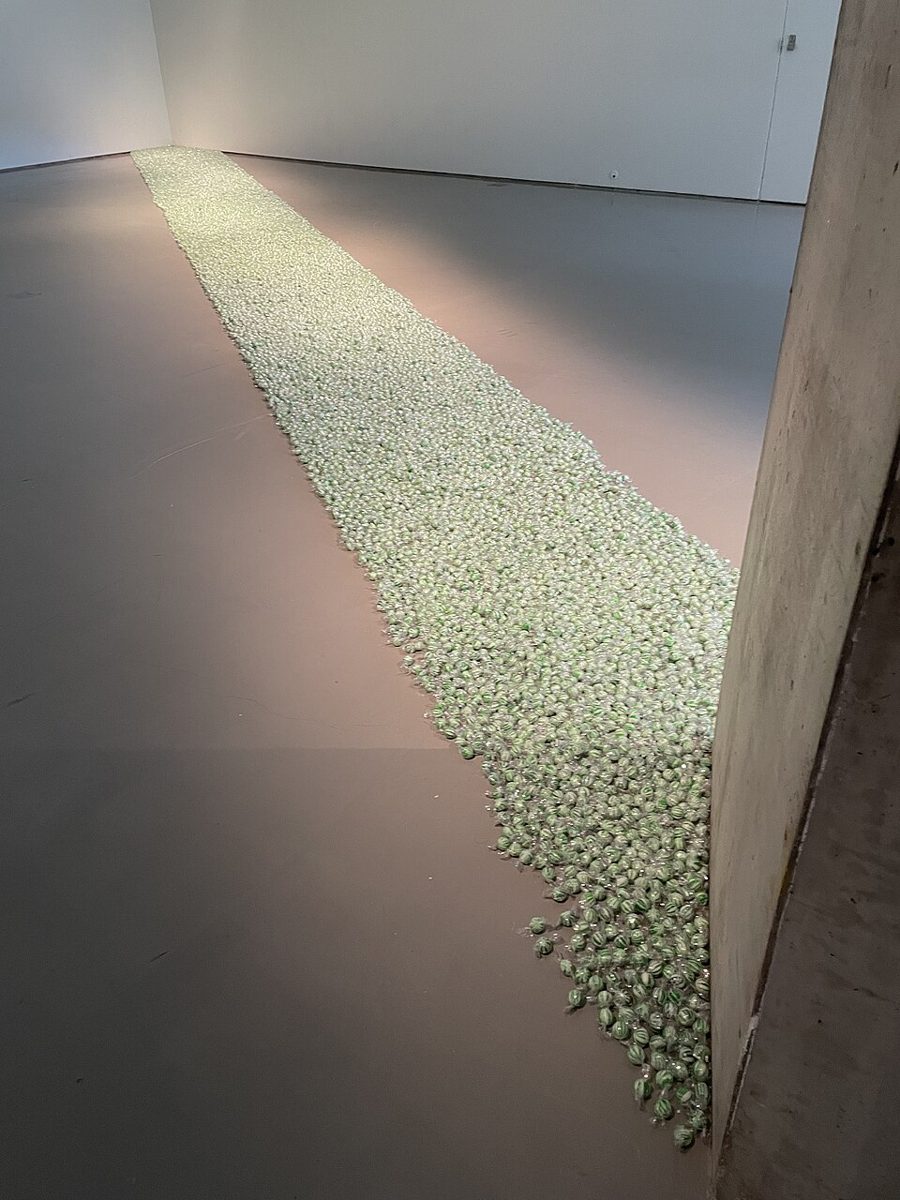
To understand installation art, treat the whole room as the work: the space, the light, the sound, the objects and your own movement through them, rather than a single object on a wall or plinth. Tate defines installation art as "large-scale, mixed-media constructions, often designed for a specific place or for a temporary period of time", and the most useful habit is to ask what that constructed situation does to you as you enter, move and leave. Look first, read the label second, then go back in and test what you were told against what you experienced.
What installation art means
The word itself is younger and slipperier than most visitors assume. According to Tate's glossary entry on installation art, such works "often occupy an entire room or gallery space that the spectator has to walk through to engage fully with the work of art", though some are made to be walked around or are so fragile they can only be seen from a doorway. The key distinction, Tate says, is that installation art is "a complete unified experience, rather than a display of separate, individual artworks."
The critic and art historian Claire Bishop traced the term in her essay But is it installation art? in Tate Etc. In the 1960s, she explains, magazines such as Artforum, Arts Magazine and Studio International used "installation" simply to describe how an exhibition was arranged, and a photograph of that arrangement was an "installation shot". Her test is still the clearest one available: a room of paintings by Glenn Brown is a display, but a room of paintings by Ilya Kabakov placed inside a fictional Soviet museum is installation art, because "the whole situation in its totality claims to be the work of art."
That test matters in practice. Galleries now use "installation" loosely, and Bishop warned in 2005 that the label had become "the catch-all description". Before you start interpreting, decide whether you are looking at an installation of artworks or at an artwork that is itself an installation.
Installation art at a glance
| Term | What it means | Example with a source |
|---|---|---|
| Installation art | A space conceived as one work, usually entered by the viewer | Kabakov, Labyrinth (My Mother's Album), 1990, Tate collection |
| Environment | Earlier name, used for 1950s and 1960s mixed-media rooms | Allan Kaprow's environments from about 1957 |
| Site-specific | Made for one location and loses meaning if moved | Rachel Whiteread, House, 1993 |
| Time-based | Has duration as a dimension: film, sound, performance, software | Tarek Atoui, Hyundai Commission, 2026 to 2027 |
Tate's definition of environments describes them as an alternative term for installation art, and the site-specific entry adds that a site-specific work removed from its location "loses all or a substantial part of its meaning".
A short history from Merzbau to the Turbine Hall
Installation art has a longer pedigree than its reputation for novelty suggests. Tate names Kurt Schwitters and his Merzbau of 1933, "an environment of several rooms created in the artist's own house in Hanover", as an important precursor. From about 1957 Allan Kaprow made environments that filled whole galleries; in an interview published in 1965 he recalled sheets of plastic, crumpled cellophane, tangles of Scotch tape, coloured cloth and "five tape machines spread around the space" playing electronic sounds he had composed.
Bishop's essay maps the decades that followed. In the 1960s and 1970s artists such as Vito Acconci saw the activated viewer as a counterweight to passive mass media. In Brazil, Hélio Oiticica invited visitors to walk barefoot on sand and straw. Bruce Nauman's video corridors of the 1970s were designed, in his words, so that "you're always on the edge of one kind of way of relating to the space or another, and you're never quite allowed to do either." The 1980s, Bishop writes, brought lavish, gigantic works by artists including Claes Oldenburg, Ann Hamilton and Cildo Meireles. Tate's glossary adds that installation became a major strand of art from the early 1990s, after the art market slump of the late 1980s revived interest in conceptual art.
In Britain, two works from that decade still shape how audiences think about the form. Rachel Whiteread's House, produced by Artangel, was a cast of the interior of the last remaining Victorian terraced house on Grove Road in east London. Artangel's project page records that it was completed in autumn 1993, demolished in January 1994, attracted tens of thousands of visitors and was debated in the House of Commons; Whiteread won the 1993 Turner Prize, the first woman to do so. In 2001 the Turner Prize went to Martin Creed, whose Work No. 227: The lights going on and off is an empty room in which the lights simply switch on and off.
Reading an installation in practice
A reliable method has five stages, and none of them requires specialist knowledge.
Stop at the threshold
Before you enter, note what is visible, audible and even smellable from the doorway. Some works, as Tate notes, are designed only to be seen from there. Your first impression is evidence, not a verdict.
Move slowly and notice your body
Walk the edges before the centre. Ask whether you are crouching, waiting, squinting or lowering your voice. Nauman's corridors and Kusama's mirrored rooms work precisely through these physical adjustments. If the work has a set path or a timed entry, that constraint is part of its meaning.
List the components
Separate the space (scale, light, acoustics), the objects, the element of time and the presence of other visitors. Then ask what holds them together. Bishop's Kabakov example shows why: the fictional museum around the paintings changes how each painting reads.
Check the context
Read the label, exhibition guide or commissioning text after your first walk. For a site-specific work, find out what the building or street was before. House only makes full sense once you know the terrace around it had already been demolished.
Go back in
A second visit, even ten minutes later, tests your first reading. Installations that seemed slight often gain depth; ones that depended on a dramatic first impression can fade.
Where to see installation art now
The most visible venue in Britain is the Turbine Hall at Tate Modern. The Weather Project by Olafur Eliasson, the fourth Unilever Series commission, ran from 16 October 2003 to 21 March 2004 and took the weather as a starting point for "exploring ideas about experience, mediation and representation".
As of October 2026, the current Hyundai Commission by Tarek Atoui runs from 13 October 2026 to 11 April 2027 and is free. Tate describes a suspended network of bamboo pipes playing shengs, Korean drums struck by mechanised mallets, Uzbek karnai horns, and textiles up to 30 metres long moving in the hall's air currents. Microphones sample the instruments and the room, and custom software plays the sounds back, "so the soundscape is always changing and no two visits are the same." Visitors can sit or lie on stones that vibrate with sound, and musicians perform inside the work on scheduled dates. It is a good case for the method above: much of the meaning sits in duration and in what your body feels, not in any single object.
Tate's page on the Hyundai Commission 2027 states that the commission has welcomed over 19 million visitors in the past decade, that the 2027 work will be the 12th in the series, and that the partnership with Hyundai Motor has been extended until 2036 (checked October 2026).
Why installations change over time
Many installations exist as instructions, equipment and agreements as much as objects. Tate's time-based media conservation team cares for works whose medium is film, slides, video, audio, performance or software and which "have a durational aspect", working closely with artists and their estates. The museum's research project Reshaping the Collectible studies recent works that "challenge the practices of the museum".
For a viewer, this has two consequences. First, the version you see may differ from earlier installations of the same work, because rooms, technology and the artist's instructions change. Second, photographs are an unreliable guide. Kabakov's view, quoted by Tate, that "the main actor in the total installation... is the viewer" cannot be tested on a screen.
Common misreadings and how to avoid them
Expecting a story. Many installations are about a condition, such as disorientation or waiting, rather than a narrative. Creed's lights going on and off has no plot; the question is what an almost empty room makes you notice.
Letting the label decide. Wall texts and guides are useful context, but they describe intentions. A critic's job is to say whether the room delivers them.
Judging by spectacle. Scale is not the same as quality. Bishop's history shows that small, austere works such as Nauman's corridors can be more demanding than the largest commissions.
Ignoring the setting. A work made for a former power station or a demolished street is partly about that place. Tate's own collection list for site-specific art includes Doris Salcedo's Shibboleth (2007) and Ai Weiwei's Sunflower Seeds (2010), both made for the Turbine Hall.
Taking it further
Choose one installation you can visit twice, write three plain sentences after each visit, and compare them. Read Bishop's Tate Etc. essay alongside a current commission; her categories will sharpen what you notice. Tate's glossary pages, the artwork entries for works such as Kabakov's Labyrinth (My Mother's Album) and Cornelia Parker's Cold Dark Matter: An Exploded View are free starting points.
For criticism and essays on contemporary art and literature, see Maria Bregman's site, and for wider arts coverage artculture.uk.